Page 24 of 262
1 18 19 20 21 22 23 24 25 26 27 28 29 30 262

Hendrik Conscience 1812-1883

Belgian author. He is considered the pioneer of Dutch-language literature in Flanders, writing at a time when Belgium was dominated by the French language among the upper classes, in literature and government. Conscience fought as a Belgian revolutionary in 1830 and was a notable writer in the Romanticist style popular in the early 19th century. He is best known for his romantic nationalist novel, The Lion of Flanders (1838), inspired by the victory of a Flemish peasant militia over French knights at the 1302 Battle of the Golden Spurs during the Franco-Flemish War.

Artist/Engraver
Size 28 x 21 cms
Price £16.00

Ref:3605

Franz Georg von Schönborn 1682-1756


Franz Georg von Schönborn was a German nobleman who served as Archbishop and Elector of Trier from 1729 until his death in 1756. He was also Prince-Bishop of Worms and Prince-Provost of Ellwangen from 1732.

Artist/Engraver
Size 19 x 11 cms
Price £18.00

Ref:3603

3560a

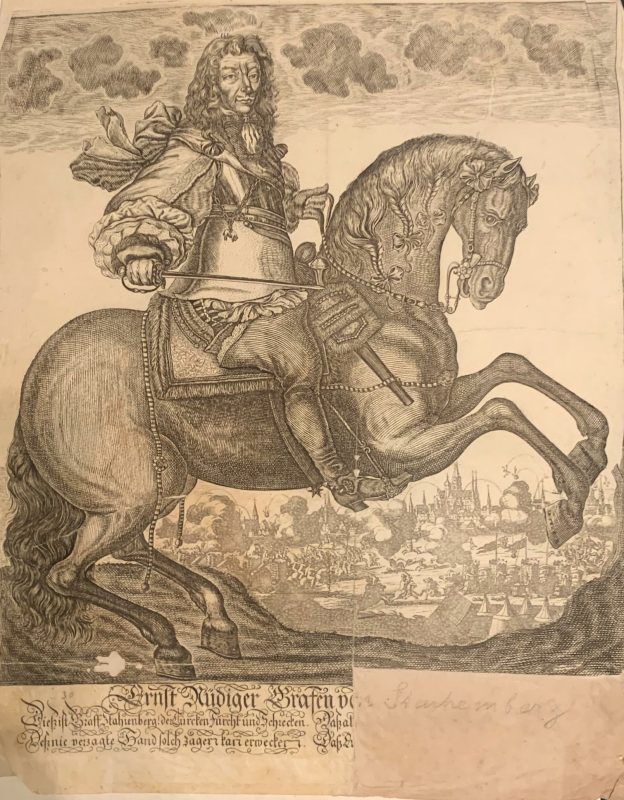
Count Ernst Rüdiger von Starhemberg 1638 -1701

Military governor of Vienna from 1680, the city’s defender during the Battle of Vienna in 1683, Imperial general during the Great Turkish War, and President of the Hofkriegsrat. Generations have idealized Starhemberg as saviour of the Western world and culture. By order of Emperor Franz Joseph I of Austria, a statue was erected in his honour in 1872 at the Heeresgeschichtliches Museum in Vienna, where the Battle of Vienna is thoroughly documented, with Starhemberg’s épée and armour on display.

Engraved by Thomas von Wiering circa 1684
Size 36 x 29 cm
(Area of lower right hand text missing as shown)

Price £78.00

Ref:3560

William V, Landgrave of Hesse-Kassel 1602-1637


Member of the House of Hesse, was Landgrave of Hesse-Kassel from 1627 to 1637. Having come to rule in unfavorable circumstances and in the midst of the Thirty Years’ War, he continued to suffer losses of territory and wealth.

Engraved by Daniel Meisner (1585 – 162
Size 14 x 9 cm

Price £38.00


Ref:3562

József Erdődy 1754-1824


Knight of the Golden Fleece, patron of Haydn’s Erdődy quartets. OP.76.  The House of Erdődy by Monyorókerék and Monoszló (also House of Erdödy) is the name of an old Hungarian-Croatian noble family with possessions in Hungary and Croatia. Elevated to the Hungarian nobility in 1459, the family was subsequently raised to the rank of Count in 1485. In 1565, the family was then recognized by the Habsburg monarchy, which granted them the title Reichsgraf / Gräfin.

Engraved by Adám Sándor Ehrenreich 1784-1852
Size 35 x 27 cm

Price £28.00


Ref:3557

Count Štefan XI. Ilešházi 1762-1838


István Gróf illésházi Illésházy (XI.) lord, politician, military officer. He was a colonel of the noble uprising against Napoleon , then a hereditary lord, and a politician sympathetic to the reform opposition from the beginning of the 1800s . From 1830, he was a director of the Hungarian Society of Scientists . The last scion of the Illésházy family, a large landowner .

Engraved by Adám Sándor Ehrenreich 1784-1852
Size 35 x 27 cm

Price £28.00

Ref:3556

Graf Franz von Zichy Ferraris 1777-1839


Fieldmarshall Lieutenant of the Garde Noble Hongroise. Father in law of Clemens von Metternich. The House of Zichy (of Zich and Vásonykő) is the name of a Magyar family of the Hungarian nobility, conspicuous in Hungarian history from the latter part of the 13th century onwards.

Engraved by Adám Sándor Ehrenreich 1784-1852
Size 35 x 27 cm

Price £28.00


Ref:3555

Page 24 of 262
1 18 19 20 21 22 23 24 25 26 27 28 29 30 262